Science
Values
What Science looks like at our school


Intent
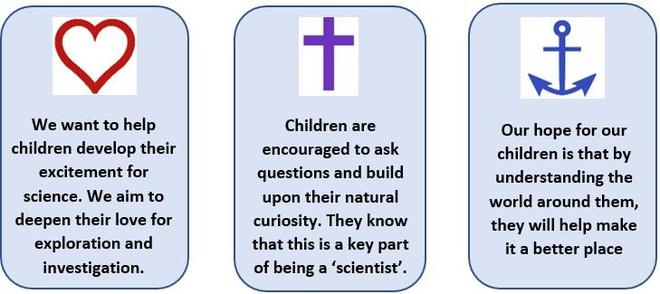
At Marchwood CofE Infant school, we know our children are naturally curious and love to ask questions. They explore outdoors from the very start of Year R and continue throughout their time with us. We want our children to leave us with a thirst for understanding the world, a memory of rich experiences, and to know how to question things in a critical and scientific way. We want out children to:
- Become curious and observant scientists.
- Observe and experience natural and human phenomena in the world around them.
- Develop their curiosity by asking questions.
- Develop scientific learning which provide children with the concepts, skills and knowledge as well as how to work scientifically.
- Engage in a balance of knowledge-based and skills-based lessons which help them answer these questions.
- Provide a rich learning experience for our young scientists to work within.
- Experiment within a safe environment where there are no ‘right’ or ‘wrong’ results.
- Develop their ability to work and discuss rationally and recognise the importance of facts and results as proof.
Implementation
-
The EYFS and National Curriculum forms the basis of teaching and learning and dictates minimum content for Science.
- The school curriculum is sequenced and organised in a way that children develop both their scientific knowledge and skills in logical and incremental way.
- Children are encouraged to be curious and observant, asking questions and working together to find answers.
-
Children are taught a scientific vocabulary to expand their thinking and reasoning skills.
- Scientific Mastery will consist of a broad use of different scientific skills and a deep and connected understanding of the knowledge laid out in the curriculum.
- Task design to orientated around wonder and observations, so that children can uncover the science prior to the explicit teacher.
- Key vocabulary is explicitly taught and encouraged to be used in answers.
- Opportunities for using their scientific skills are used in other subjects.
- Teachers will use the provided knowledge organisers to design and teach their lessons, ensuring all children can access the relevant learning.
- Children will evaluate their own understanding within their science books.
- The use of different scientific skills will be recorded within the science books through the use of the provided symbols.
Inclusion
When planning lessons, we consider every child and their individual needs. Teachers consider the barriers and key learning of each lesson. Teacher consider how to:
- Present new information in a way that all learners can access
- Break down complex ideas into simpler parts for pupils to learn and practice
- Ensure children are clear on new content
- Use visuals to support the access of all learners
- Aid scientific discussions, so that learners are able to engage in the internal thought processes needed for science.
If appropriate, we plan for an additional adult in the lesson and share their responsibilities with them in advance
Impact
- Children develop a love of science.
- Children become naturally curious and ask questions about how the world works.
- Children develop an understanding of what scientists do.
- Children see themselves as scientists.
- Children use their skills to observe the science and then learn the relevant knowledge from a range of mediums.
- Children apply their skills and knowledge within their science books.
- Children have been monitored if there are working towards expectations set out in the National Curriculum and receive a grade at the end of KS1.