
Maths
Values
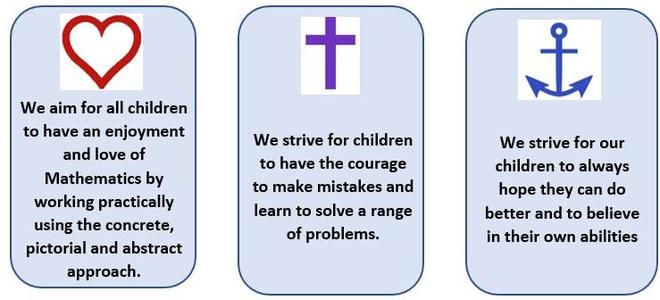
What Mathematics looks like at our school.


Intent
Our intent for Maths at Marchwood Church of England Infant School is –
- To introduce children to an appreciation of maths that will last a lifetime.
- For all children to become fluent in the fundamentals of maths
- For children to be able to reason mathematically
- To enable children to verbalise and discuss their thinking with others
- That children will solve problems by applying their mathematical skills and knowledge to solve increasingly sophisticated problems
- Encourage children to make connections between mathematical ideas (e.g., if I know this, what else do I know?)
- Give children the opportunity to explore, develop and communicate their own creative ideas and responses.
- Provide a ‘safe’ environment where there are no ‘right’ or ‘wrong’ results so children are enabled to be brave enough to take mathematical risks, problem solve and reason in
- To encourage children to problem solve and record in a range of ways.
- To enable pupils to become proficient in four mathematical operations (+-x /)
- Ensure children feel valued and feel successful with maths
- To enable children to recognise that not knowing is the first step to understanding
Implementation
- The EYFS and National Curriculum forms the basis of teaching and learning and dictates the curriculum content for Maths.
- EYFS use Mastering Number and Key Stage 1 use NCETM materials.
- Wherever possible, first-hand experiences and real things are used to support learning. New techniques and skills are modelled and examples of work are shown to the children.
- Coherent and sequenced teaching
- Varied and frequent practice
- Task design and access points support all pupils to make progress from their relative starting points.
- Opportunities for using and extending Maths skills are built into lessons in other subjects.
- Vocabulary is explicitly taught.
- Deep conceptual understanding of maths is built through the use of appropriate mathematical structures. This is supported by a CPA approach.
- Opportunities for reasoning are threaded throughout each lesson.
- Children demonstrate understanding through discussion and jottings that communicate their thinking, answering questions such as “what do you see, what do you notice?”
- Tasks will be designed to enable children to explore and represent mathematical structures and deepen their understanding.
- Working walls reflect the importance and enjoyment of maths
Inclusion
When planning lessons, we consider every child and their individual needs. Teachers consider the barriers and key learning of each lesson. Teacher consider how to:
- Present new information in a way that all learners can access
- Break down complex ideas into simpler parts for pupils to learn and practice
- Ensure children are clear on new content
- Use visuals to support the access of all learners
- Aid mathematical discussions, so that learners are able to engage in the internal thought processes needed for mathematics
If appropriate, we plan for an additional adult in the lesson and share their responsibilities with them in advance
Impact
- Children have developed a love of maths and have a growing confidence in applying their knowledge.
- Children have developed a strong number sense.
- Children feel confident to use a variety of resources and structures when approaching a maths task.
- Children experience maths through other areas of the curriculum.
- Children have a good understanding of how maths can be used in real life contexts.
- Children have increased their perseverance and seek out challenge.