Religious Education
Values
What Religious Education looks like at our school


Intent
As a Church of England School we want to help our children prepare for the future by:
- Developing awareness of the fundamental questions raised by human experiences, and of how religious teachings can relate to them.
- Responding to such questions by referring to the teachings and practices of religions and other belief systems, relating them to their own understanding and experience.
- Reflecting on their own beliefs, values and experiences.
We aim
- To reflect on what it means to have a faith and to develop their own spiritual knowledge
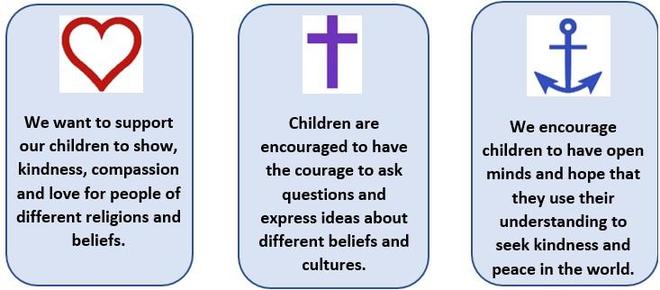
- To celebrate diversity and develop sensitivity and respect towards other people's views and cultures.
- To enable children to make their own informed decisions and to have the confidence to voice their views.
- To ensure RE is a subject for all pupils whatever their background, personal beliefs and practices.
- To learn from religions as well as about religions so they can understand the world around them.
- To develop children's understanding of world faiths and other beliefs by exploring their commonality and diversity.
- For children to enjoy RE and develop resilient responses to misunderstandings, stereotyping and division.
- To offer our children a place where difficult or 'risky' questions can be tackled within a safe but challenging context.
- To provide our children with religious literacy where they will develop their knowledge and understanding of Christianity, other religious traditions and world views and explore their responses to life's challenges. This gives pupils the knowledge and skills to flourish both within their own community and as members of a diverse and global society.
- To develop an awareness of the spiritual and morals arising in their lives.
Implementation
- The EYFS and National Curriculums alongside Hampshire Living Difference IV forms the basis of teaching and learning and dictates the curriculum content for RE.
- Wherever possible, first-hand experiences and class discussions are used as a stimulus for RE. In group and individual work, pupils have the opportunity to develop their knowledge of Understanding Christianity, and children gain a deeper understanding of the religion studied through the use of high quality resources / artifacts.
- Task design and access points support all pupils to make progress from their relative starting points.
- Opportunities for using and extending knowledge are built into lessons in other subjects.
- RE is taught in a block unit within a term to build on children's understanding and allow suitable links to be made to specific religious festivals taking place or to link in with other topics being taught.
- During each year group pupils are taught knowledge, skills and understanding through learning about Christianity and Judaism. Each unit of work identifies prior learning and shows how this is built upon.
- Collective Worships take place across the whole school and in classes; these are delivered by senior leaders, class teachers and our local vicar.
Inclusion
The Religious Education (RE) curriculum is intentionally designed to be precise, inclusive, and responsive to the diverse needs of all learners. It ensures that every pupil receives equitable access to high-quality RE, with adaptations made to support individual learning profiles and promote success for all.
Teachers carefully identify potential barriers to learning and plan lessons around clearly defined objectives, focusing on the introduction of new and essential knowledge. To support effective delivery and engagement, teaching strategies include:
- Introducing specialist vocabulary with visual aids to reinforce understanding
- Sequencing concepts into manageable steps to support mastery before progression
- Making meaningful connections between curriculum content and pupils’ lived experiences
- Using photographs, video clips, and artefacts to bring unfamiliar practices to life
- Ensuring all pupils can engage with new content and express their ideas and beliefs through creative mediums such as art and technology
This approach reflects a commitment to high expectations, accessibility, and deepening pupils’ understanding of religious and cultural diversity
Impact
- Children demonstrate a positive attitude towards people of any religion and show an understanding of cultural beliefs different to their own.
- They demonstrate respectful behaviour to all and this is transferable outside of school in the wider community and beyond.
- Assessing children’s understanding of each unit’s linked vocabulary takes place before and after the unit is taught.
- Images and videos of the children’s learning show progression across the school
- Pupil voice is used to further develop how RE is taught in school.
- Scrutiny og children's books shows there is the opportunity for a dialogue between teachers to understand their class’s work.
- Marking of written work in books is used as effective, purposeful feedback
- Teachers have a deep understanding of how to teach the skills of RE through the use of detailed medium term plans.