
Computing
Values
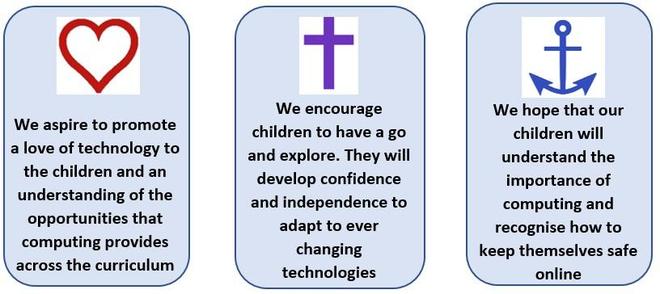
What computing looks like in our school


Intent
- To expose all children to the wide variety of technology, giving them a chance to experience, practise and implement a wide range of computing skills and knowledge.
- To help children to understand how to use technology responsibly and how to keep themselves safe whilst using the internet.
- To enable children to become proficient in: computing skills including word processing, graphics, sound recording and videos.
- To introduce children to computing programming and provide opportunities for children to practise writing and inputting their own algorithms.
- To give children the opportunity to use their computing skills individually and collaboratively to support their learning in other curriculum areas using a wide range of media.
- To allow children to experiment, invent and create in a ‘safe’ environment where there are no ‘right’ or ‘wrong’ results.
- To provide meaningful opportunities for children to apply their computer skills within the school and local community e.g. contributing to the school website, creating posters for local events.
Implementation
- The EYFS and National Curriculum forms the basis of teaching and learning and dictates minimum content for Science.
- Children's learning is sequenced and broken down into manageable chunks to reduce cognitive overload.
- Children have access to a range of practical activities to support their understanding.
- Clear thought is given to the teaching of how to children safe whilst using technology.
- Key vocabulary is identified and explicitly taught to children.
- Over time, children are given more choice over their use of technology and the final outcomes.
- The Computing skills progression and provision map supports planning and ensures there is progression in the development of key skills.
- In group and individual work, pupils have the opportunity to develop, refine and experiment, record and present their ideas and techniques.
- Children have the opportunity to work individually, in pairs and in group situations.
- Task design and access points support all pupils to make progress from their relative starting points.
Inlcusion
We are committed to inclusion and believe every child is entitled to a computing curriculum that may be adapted to their individual needs.
Thought is given to how all learners access the curriculum at their level while always providing scope for accelerated progress.
We provide suitable learning challenges appropriate to the diverse needs of all children and to overcome learning barriers, a range of curriculum adaptations are provided e.g. consistent terminology, adapted computing equipment or programmes, alternate language keyboard overlays and practical opportunities to reinforce knowledge through physical computing.
Impact
- Children have developed an understanding of how technology can be used to express their ideas and to communicate with others.
- Children are able to apply their computing skills to support their learning in other curriculum areas e.g. making a PowerPoint presentation to display facts about wolves and owls.
- Children are able to use technology responsibly and can identify how to keep themselves safe whilst online.
- Children have a wide range of opportunities to express themselves creatively e.g. Video presentations, animated storybooks.
- Children acquire key skills and make progress with these.
- Children have the confidence to evaluate their own and others’ work and know how to progress.
- Children have the opportunity to develop skills and interests within and outside of the curriculum.
- Children are exposed to a wide range of technology and its uses which have developed their knowledge in a range of areas .
- Teachers have a deeper understanding of how to teach the skills of computing through the use of detailed medium term plans.