
Design and Technology
Values
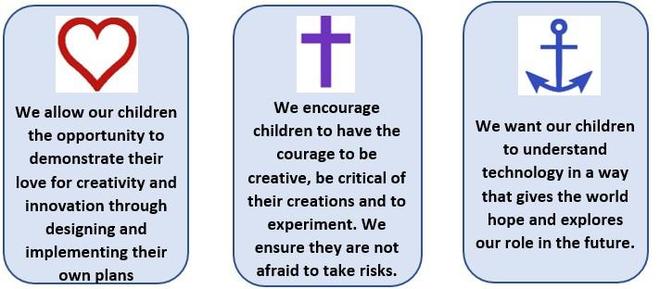
What DT looks like in our school


Intent
- For children to be inspired to work both collaboratively and independently to create innovative designs which solve real and relevant problems within a variety of different contexts.
- Opportunities provided for children to explore, develop and communicate their own ideas and responses.
- Children to feel confident to take ambitious risks.
- Children to think critically; reflecting on, evaluating and improving their work and the work of others.
- Children to be able to experiment, invent and create in a ‘safe’ environment where there are no ‘right’ or ‘wrong’ results.
- All children to express themselves creatively and imaginatively in a variety of contexts using a wide range of media and materials.
- Children to develop a range of practical skills and become proficient in designing, making and evaluating products.
- Children to understand how to make healthier lifestyle choices when it comes to their diet.
Implementation
- The EYFS and National Curriculum forms the basis of teaching and learning and dictates the curriculum content for Design Technology.
- Our Design Technology skills progression and provision map supports planning and ensures there is progression in the development of key skills.
- Wherever possible, first-hand experiences and real things are used as a stimulus for design activities. New techniques and skills are modelled and examples of work are shown to the children.
- In group and individual work, pupils have the opportunity to develop, refine and experiment, record and present their ideas and techniques.
- Children have the opportunity to use a wide range of materials and resources, including ICT and will be supported to use tools and equipment safely and responsibly.
- Children have the opportunity to work individually, in pairs and in group situations.
- Task design and access points support all pupils to make progress from their relative starting points.
- Opportunities for using and extending design technology skills are built into lessons in other subjects.
- Vocabulary is explicitly taught.
Inclusion
We are committed to our inclusive practise and believe that every child is entitled to a design and technology curriculum that may be adapted to their individual needs. To overcome learning barriers, a range of scaffolding is provided eg: consistent terminology, displays to support understanding of challenging concepts and practical opportunities to reinforce knowledge. We also ensure that we give every child scope to extend their learning.
Impact
- Children have developed a love of being resourceful problem solvers and have the confidence to express themselves.
- There is evidence of a development of understanding and skills in design, making and evaluation.
- Children have a wide range of opportunities to express themselves creatively.
- Children acquire key skills and make progress with these.
- Children are confident to evaluate their own and others’ work and know how to progress.
- Children have the opportunity to develop skills and interests within and outside of the curriculum.
- Children are exposed to a wide range of designers which has developed their knowledge in a range of areas
- Teachers have a deeper understanding of how to teach the skills of Design Technology through the use of detailed medium term plans